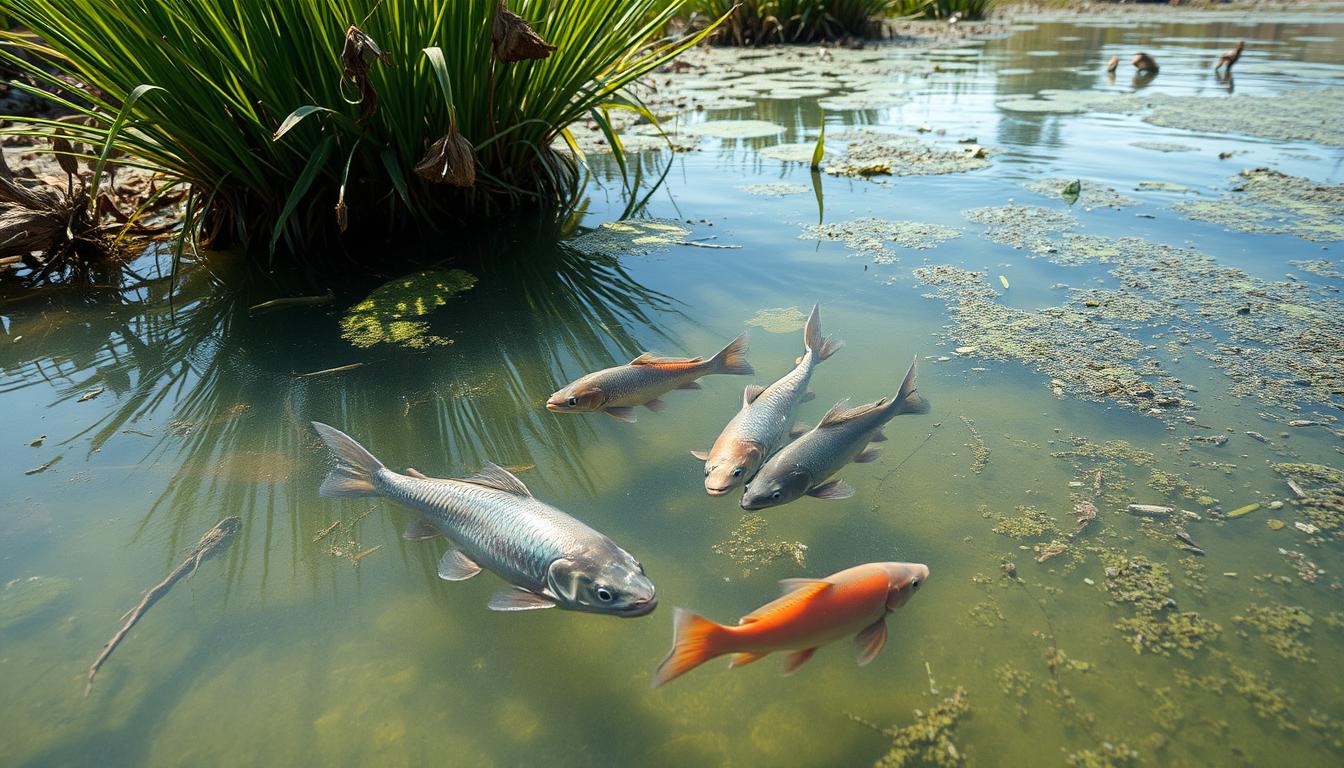
Adding a bit more food might seem harmless, but it’s not in small spaces like home aquariums or ponds. Overfeeding leads to too much uneaten food and waste. This waste adds harmful nutrients to the water, posing risks to all living things.
Feed costs can be up to 60% of the budget in fish farming, as FAO research by Patrick G. White points out. Bad feeding habits can make you waste money and pollute the environment. Claude E. Boyd’s work shows most feed doesn’t turn into animal tissue but into waste instead.
Real-life examples show the dangers. In the Philippines, too much food in fish cages harmed the water and the bottom. Small areas can’t handle excess food well. A big feeding can quickly change water quality, harming fish and plants.
Keep reading to find out how to spot nutrient buildup early. Adjusting your feeding can save your aquatic friends and cut costs.
Understanding Overfeeding in Aquatic Environments
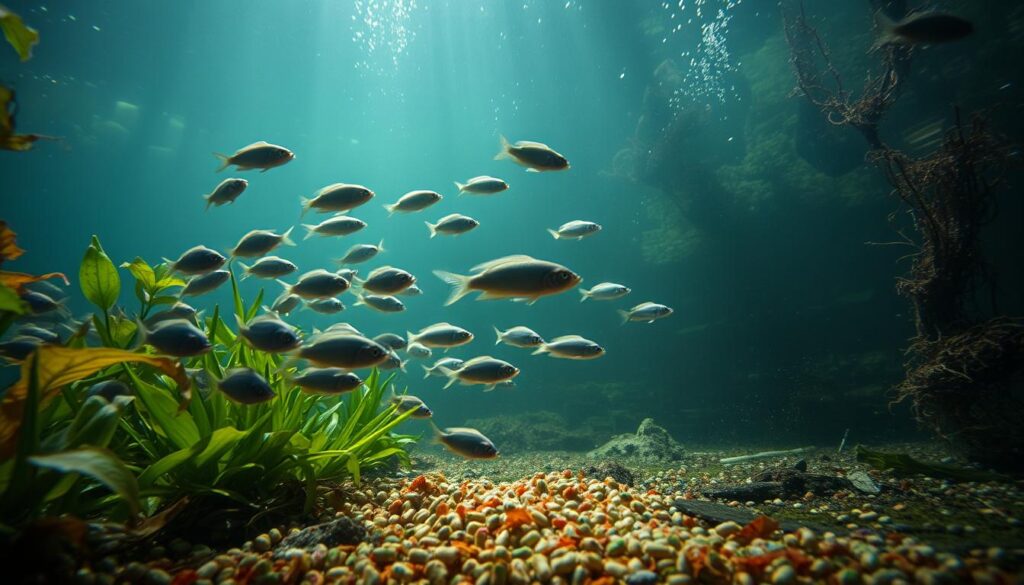
You often think your fish need more than they do. Owners feed during social times and reward fish for coming up. This makes fish seem hungrier than they really are. This behavior causes overfeeding in both home and commercial systems.
Not all food is eaten. Careful feeding can ensure 90 percent of fish food is consumed. Shrimp and some crustaceans might leave up to 40 percent uneaten, says Claude E. Boyd. About 70–80 percent of what is eaten is absorbed.
Not all absorbed nutrients turn into body mass. Much is respired or excreted as water, CO2, ammonia, and phosphate. Only a small part of feed is kept in biomass. This explains the metabolic impact of overconsumption and the water quality issues you see.
Systems handle excess differently. Ponds, cages, and tanks have unique ways of dealing with waste, notes Ronald W. White. Freshwater is often phosphorus-limited, while marine systems are nitrogen-limited. Which nutrient is scarce affects how algal blooms respond to excess feed.
Improper feeding can start a chain reaction. It creates immediate waste, which spikes nutrient loads and fuels algal growth. Overfeeding consequences include oxygen swings and changes in species composition. These outcomes are linked to the nutrient imbalance you want to avoid.
- Behavioral drivers: social feeding, cue-driven requests, owner overestimation.
- Feed fate: uneaten feed, fecal loss, 70–80% absorption of consumed feed.
- Partitioning: respiration, excretion, limited biomass retention.
- System differences: ponds vs. cages vs. tanks; phosphorus vs. nitrogen limitation.
The Impact of Overfeeding on Water Quality
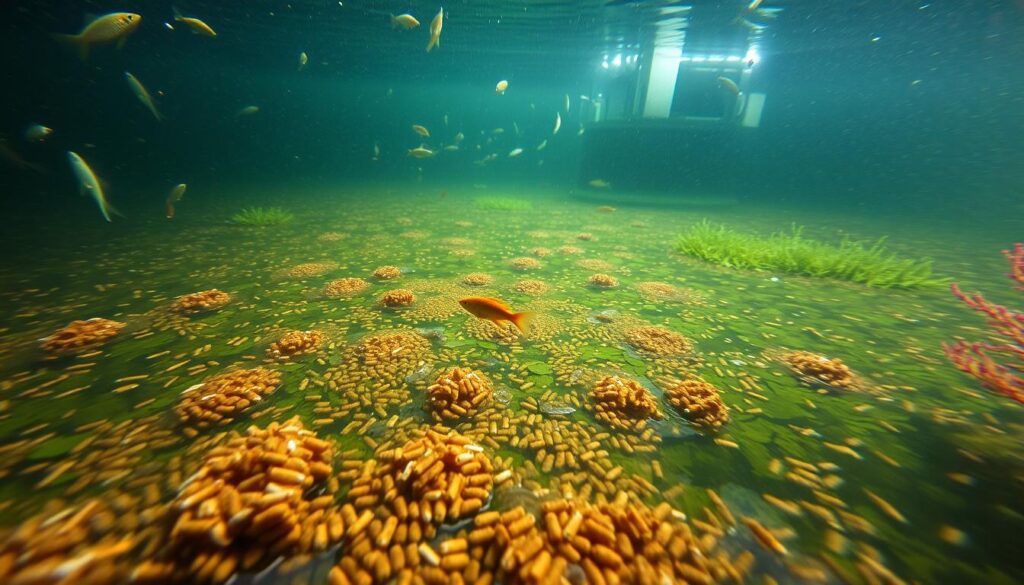
Overfeeding a tank or pond leads to uneaten food and feces breaking down. This releases ammonia. Metabolic wastes also add to the problem. These factors increase high ammonia and nitrites, which harm fish and invertebrates.
Microbial decomposition uses oxygen. As microbes digest, dissolved oxygen drops and CO2 increases. You might see dense plankton blooms. These blooms cause oxygen levels to swing, being high during the day and low at night.
Feeding too much can lower oxygen levels at night. To avoid this, you might need to add aeration. This helps keep oxygen levels safe for your aquatic life.
Decomposition also lowers pH, making water more acidic. This stress affects species that like alkaline water. It’s important to watch pH levels after heavy feeding to protect your fish.
- Particulate nutrients settle and enrich sediments, creating anoxic benthic zones.
- Dissolved nutrients disperse rapidly through the water column and fuel algal growth.
- Benthic anoxia can produce hydrogen sulfide, which harms bottom-dwelling organisms.
Filters get clogged with excess waste. This reduces their efficiency. Clogged filters can lead to sudden spikes in ammonia and nitrites, posing water chemistry risks.
Excessive food consumption has adverse effects. It can lead to poor water quality, stressed fish, and increased maintenance. This is true for both aquaculture and hobby setups.
To avoid these problems, adjust your feeding rates. Monitor oxygen and nitrogen levels. Keep your filtration and aeration systems working well. Small changes in feeding can prevent major issues in your aquatic environment.
Nutrient Pollution: A Hidden Danger
Feed rarely turns into fish or shrimp completely. Studies by Boyd and White show most feed nitrogen and phosphorus go back into the water. This imbalance harms your system and nearby habitats.
When phosphorus is scarce in freshwater, a little extra can cause blooms. In marine waters, nitrogen is often the key. Adding the missing nutrient can speed up eutrophication and change water clarity quickly.
Phosphorus can settle in sediments over time. These sediments trap P and other organics. If they get too full, they become anoxic, harming seagrass and coral, and changing the bottom life.
Your feed conversion ratio is important. A worse FCR, like going from 1.6 to 2.0, means more phosphorus and nitrogen. Boyd’s work shows higher FCRs lead to more nutrients, causing problems in small or enclosed bays.
Local currents and flushing decide if impacts stay close or spread along the coast. Poor flushing means nutrients build up, raising eutrophication risk and slowing recovery for your local ecosystem.
Think about the big picture of overconsumption. Too much feed leads to a chain reaction: uneaten pellets and waste increase nitrogen and phosphorus, boost algae, and cause the problems you want to avoid.
- Track FCR and reduce waste to limit nutrient imbalance drawbacks.
- Choose sites with good flushing to lower eutrophication risk.
- Monitor sediments for accumulated phosphorus before anoxic shifts occur.
Monitoring Food Intake: Best Practices
Set a proper feeding schedule and stick to it. Feed smaller amounts more often. This way, fish eat what you offer in about 4–5 minutes. Use the number-of-inhabitants, not tank volume, to determine each ration.
This reduces overfeeding consequences and limits algae overgrowth. Algae overgrowth can look like obesity from overfeeding.
Watch eating behavior daily. Note uneaten pellets and cloudy water. Record feed times and amounts so you can adjust rations quickly.
Solid feed management cuts waste and keeps nutrient loading low.
- Pre-measure rations for sitters and caretakers to prevent double feedings.
- Use automatic feeders when you’re away to maintain a consistent, proper feeding schedule.
- Train household members on the plan to avoid accidental overindulgence repercussions.
Monitor early-morning dissolved oxygen to gauge assimilation capacity. Keep DO above 3–4 mg/L in the morning. If levels fall, reduce feed or boost aeration.
This practice links monitoring food intake with water-quality control.
Match feed formulation to species, season, and life stage to optimize feed conversion ratio (FCR). Lower FCRs mean less nutrient output. For reference, salmon FCRs target near 1.2:1 while milkfish can reach 2.8:1.
Good feed management and quality reduce fines and leaching. This worsens overfeeding consequences.
Store feeds properly to avoid stale pellets and broken pieces that leach nutrients. Choose well-balanced feeds with correct protein and energy for your species. Proper handling cuts waste and keeps nutrient inputs predictable.
Use simple tools and metrics: feeding logs, morning DO checks, and occasional FCR estimates. These steps give you clear data. They help prevent overindulgence repercussions and refine your monitoring food intake routine over time.
The Health Implications for Fish and Other Species
Overfeeding can harm individual fish and the whole community. It can cause fatty liver in fish, like in African cichlids and rainbowfish. At low temperatures, digestion slows down. So, switch to wheat-germ food below 60°F and stop feeding below 50°F to avoid strain.
Poor water quality from too much food raises ammonia and nitrite levels. It also lowers dissolved oxygen and pH. These changes stress fish and make them more likely to get infections like fin rot. Constant stress weakens their immune system, making them more susceptible to diseases.
In crowded or small systems, too much food can cause low-oxygen events and kill many fish. Sediments that turn anaerobic can release harmful gases. These gases can be toxic and kill fish, making recovery harder.
Your actions also affect the ecosystem around you. Overfeeding can lead to algal blooms that change food webs and harm habitats. It can also harm wild fisheries, seagrasses, and corals. Waste from overfeeding can change the bottom of water bodies and harm creatures that live there.
- Watch feeding rates to prevent overeating complications.
- Adjust diets by temperature to avoid fatty liver in fish.
- Monitor ammonia, nitrite, and dissolved oxygen to limit stress and fin rot risk.
- Reduce nutrient runoff to prevent algal blooms and broader overfeeding consequences.
Understanding the Role of Filtration Systems
Your filter is the first defense against water quality problems. It catches uneaten food and solids. It also hosts bacteria that clean up harmful substances.
But, if you feed too much, your filter gets clogged. This blocks water flow and lowers oxygen levels. This stress can harm fish and other creatures.
Removing nutrients from the water is another challenge. Small tanks often can’t handle this. You need to plan your filtration system carefully before adding more fish or food.
To ease the load, clean or replace your filter media regularly. Add more bio-media if you have more fish. Use aeration to keep oxygen levels up when you feed more.
- Match filter flow and media to your stock levels.
- Inspect for clogged filters after heavy feedings.
- Include scavengers like Corydoras or loaches to cut uneaten food, but don’t rely on them alone.
Good feed management helps your filters work better. It keeps the water clean. By feeding right and upgrading your filtration, you can avoid many problems.
The Ecological Balance of Aquatic Habitats
Feeding practices can greatly affect the balance in ponds, cages, and enclosed bays. The speed at which nutrients spread depends on local water movement and depth. Places with poor water flow hold nutrients longer, increasing the risk of eutrophication.
Carrying capacity is the maximum amount your system can handle without harm. Too much nutrient input can exceed this limit, causing algal blooms. These blooms then lead to low oxygen levels and harm fish and other bottom-dwellers.
Different culture systems react differently to feeding. Ponds can remove some waste through sedimentation and plant growth. But, draining them at harvest releases more nutrients. Cage culture, on the other hand, sends waste straight into open water, making overfeeding worse.
Consider the long-term effects of sediment when setting feeding rates. Repeated nutrient inputs can fill up sediment’s ability to hold phosphorus. Even after drying pond bottoms, sediments can keep releasing nutrients, causing algae to grow too much.
- Monitor nutrient loading to respect carrying capacity for your site.
- Match feed rates to local hydrodynamics to cut down eutrophication risk.
- Limit overfeeding consequences by adjusting schedules and using more efficient feeds.
By managing feeding with your site’s needs in mind, you can reduce nutrient imbalance and overfeeding in algae. This approach keeps the water healthier and supports more stable production over time.
Mitigating the Consequences of Overfeeding
To lessen overfeeding issues, tighten up your farm’s feed management. Adjust how much, when, and how often you feed. Make sure it fits the species, size, season, and water temperature. This helps avoid waste and keeps nutrients in balance with what the water can handle.
Use different diets for different growth stages to use nutrients better. Choose high-quality feeds with the right mix of protein and energy. Also, improve how you handle and store feed to cut down on waste.
For extra help, consider mechanical solutions. Add aeration to keep water oxygen levels high in ponds. Increase filtration in tanks and do regular maintenance to avoid clogs.
Think about using systems where different species help clean up excess nutrients. In enclosed areas, limit farm size and choose locations that are better for water flow. This helps avoid pollution problems.
- Check water quality early in the morning every day.
- Adjust feeding or add water and aeration if levels start to rise.
- Set limits on feed use and promote good feed management.
By combining careful feed management with mechanical solutions and integrated systems, you can improve feed conversion rates. This approach also reduces pollution without sacrificing production.
Educating Others on Responsible Feeding Practices
You can lead effective public outreach by teaching simple, clear rules that prevent overfeeding. Show hobbyists and producers how to use portion control. Feed fish what they consume in four to five minutes.
Recommend single-person or logged feeding routines to avoid duplicate feedings. Use local case studies like Bolinao milkfish impacts to illustrate overfeeding consequences.
For aquaculturists, focus on feed conversion ratio (FCR), feed formulation, and feeding strategies. Teach them to match these to species and site hydrodynamics. Encourage routine monitoring of dissolved oxygen and nutrient indicators.
These steps help reduce overfeeding consequences like algal blooms and benthic damage. They also improve animal health and yields.
Provide practical tools to change behavior. Distribute feeding charts and checklists for filter and aeration maintenance. Recommend automatic feeders with pre-measured rations for vacations.
Frame outreach around both animal health and environmental stewardship. This way, your audience connects responsible feeding practices with better health and less harm to ecosystems.
Build community momentum. Urge aquarium societies and local aquaculture groups to host workshops and share best practices. Support incentives for higher-quality feed and lower FCR to cut costs and environmental impact.
Through consistent educating on feeding and clear resources, you can help others prevent overfeeding. This protects water quality for the long term.
Leave a Reply