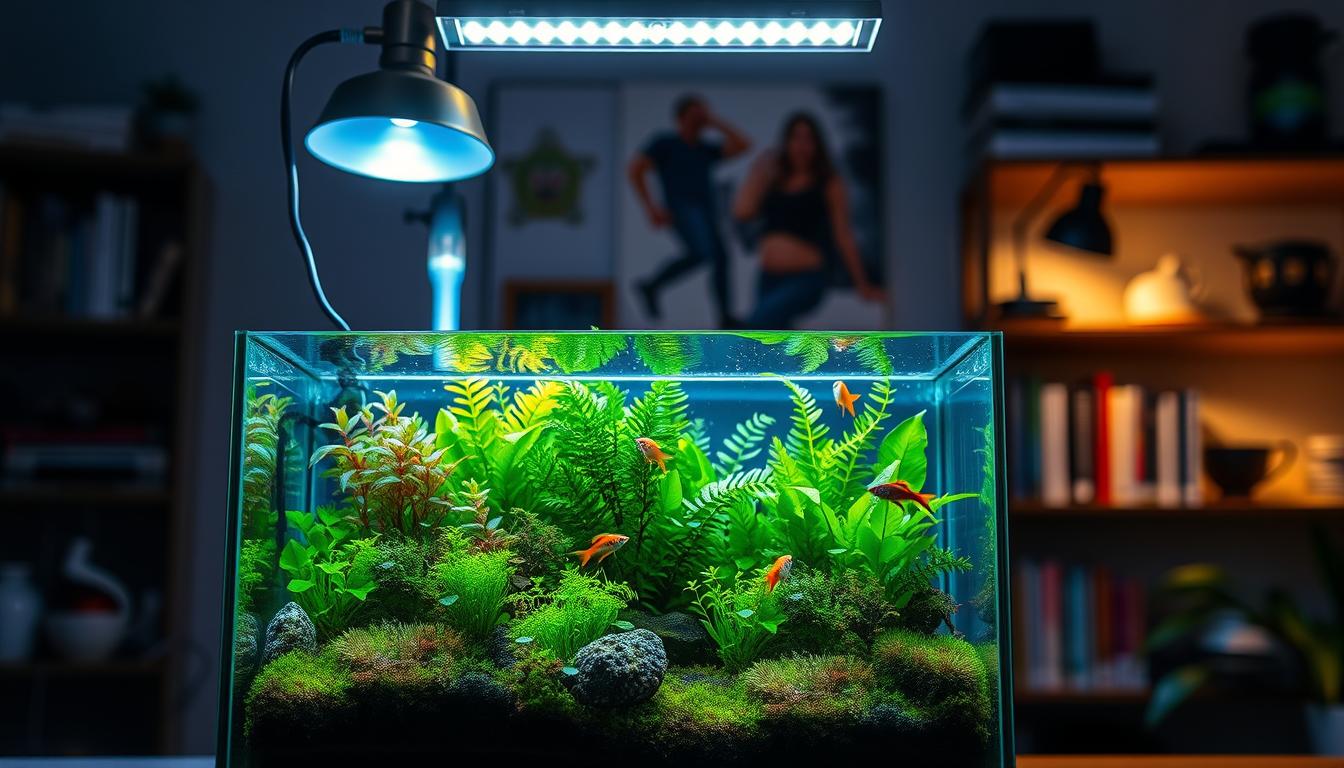
Setting up a small aquarium raises a key question: how much light does your nano tank need? The answer varies based on several factors. These include the plants you choose, the tank’s depth, the lighting fixture, and the desired look of your aquascape. Options range from nano tank LED strip lights to compact T5 or T8 fixtures, each affecting the light plants receive.
Understanding lumens, watts, and PAR is key to comparing lighting options. Manufacturers often list lumen output and wattage. Yet, PAR (Photosynthetically Active Radiation) is more accurate in predicting plant response. Historically, hobbyists used watts-per-liter or watts-per-gallon rules. But these vary greatly with LEDs, T5s, and metal halides.
Lumen guidelines can aid in planning: low-light plants thrive at 10–25 lumens per liter. Medium-light species prefer 20–50 lumens per liter, and high-light plants need 40–50+ lumens per liter. If possible, check PAR values. Community ranges suggest low-light plants need about 75–100 μmol/m²/s, medium-light species around 150 μmol/m²/s, and high-light plants 200+ μmol/m²/s.
This article will guide you in choosing the best lights for nano aquariums. You’ll learn about using nano tank LED strip lights, setting light duration and position, and avoiding common lighting mistakes. You’ll also get tips on maintenance, budgeting, and the latest in nano tank lighting. This will help you plan a healthy, beautiful nano aquarium.
Understanding Nano Tanks and Their Lighting Requirements
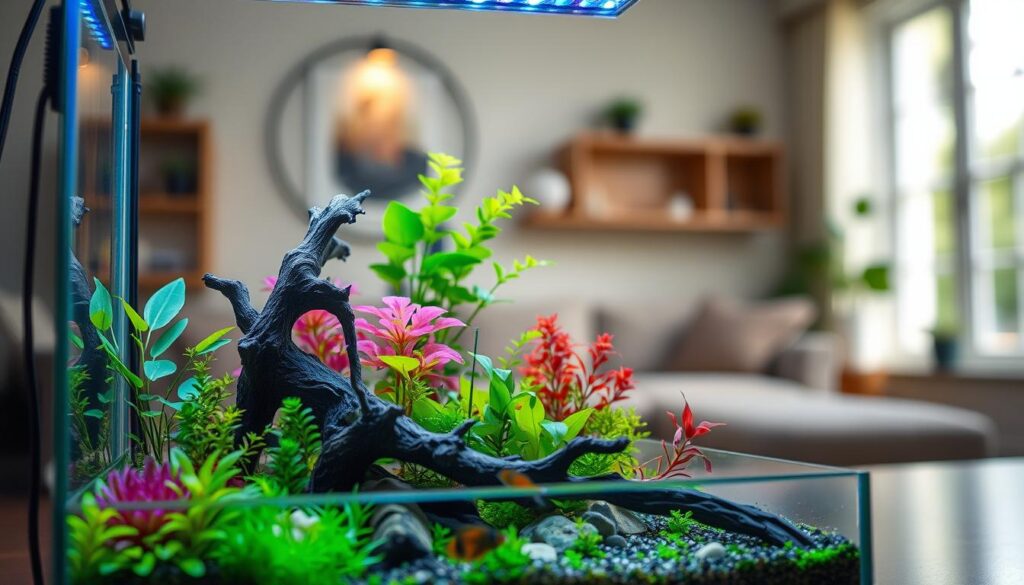
A nano tank is small, under about 10 gallons (roughly 40 liters). It has a compact depth and small surface area. This size affects how light behaves, unlike larger tanks.
Shorter distances in nano tanks mean bright light reaches the center fast. But, light falloff from center to corners can be sharp.
When picking nano tank lighting, consider its footprint and depth. Deeper tanks need stronger lights and better beam spread. Wider tanks might need two smaller lights or a wide-beam fixture.
Plant choice affects the light intensity needed. Easy plants like Java fern and Microsorum pteropus need about 10–20 lumens per liter. Medium-demand plants do best near 20–40 lumens per liter. Advanced plants and dense carpeting plants need over 40 lumens per liter.
Match your lighting to the plant type. For low-light plants, choose modest output lighting. For carpeted scenes, go for higher output and check PAR at the substrate.
Don’t forget about other factors. CO2, flow, and nutrients also affect plant health. High light without CO2 and proper nutrients can lead to algae and poor health. Balance your lighting with good filtration, circulation, and fertilization for the best results.
- Define the tank: under ~10 gallons, compact depth and footprint.
- Assess plants: Easy (10–20 lumens/L), Medium (20–40 lumens/L), Advanced (>40 lumens/L).
- Consider layout: depth needs intensity, wide tanks need broader coverage.
- Balance systems: CO2, flow, and nutrients must match light level.
Look at nano tank lighting options before buying. Compare by lumen output, beam angle, and PAR. Choose reliable brands like Fluval, NICREW, or Finnex for your small aquarium.
Types of Lighting for Nano Tanks
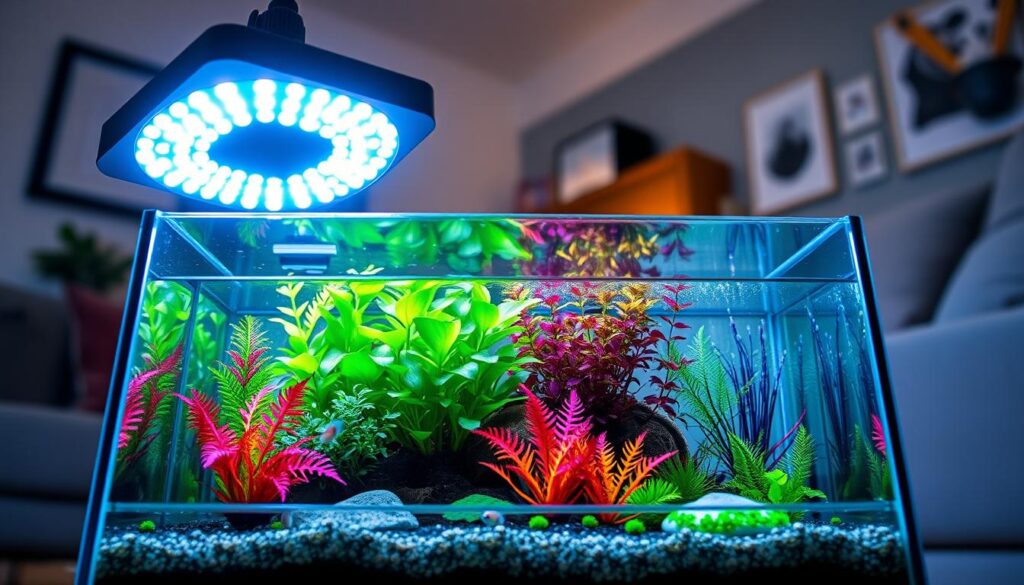
You have many lighting options for a nano tank. Each has its own pros and cons. Choose based on your plants, fish, heat tolerance, and tank size.
-
Incandescent — not good for aquariums. They waste energy, get too hot, and stress fish. Don’t use them in a planted nano tank.
-
Metal halide — very bright but hot. It’s a big debate with LED. Metal halide is intense but hard to use in small tanks because of heat and maintenance.
-
Fluorescent (T12, T8, T5) — once common, now useful in some cases. T5 tubes are brighter than T8. For example, a 15W T8 makes about 900 lumens, while a 24W T5 makes 1600 lumens. Reflectors help a lot. But, fluorescents spread light and age faster than LEDs.
-
LED — the best choice for many nano tanks. LEDs are energy-efficient, cool, and last long. They can be as bright as metal halide but without the heat. You can find LED bars, strips, and fixtures to fit your tank.
Where you place LEDs is key. A single bar can light the center well but leave corners dark. Using many small lights or bars spreads light evenly. Many people like using two bars or a strip to cover the whole tank.
When buying, look for PAR charts on the packaging. Lumen numbers are common, but PAR is better for plants. If no PAR chart is available, read reviews and watch videos of tanks under that light.
Choose your lighting based on your needs. For easy care and low heat, go for LED. For high-light species and managing heat, compare metal halide and LED.
Factors That Influence Lighting Needs
Choosing the right nano tank lighting involves several factors. The type of plants and your skill level are key. For example, easy plants like Java fern do well with low light. But carpet plants need more light and CO2 to grow well.
The depth and size of your tank also matter. Deeper tanks block more light, and light spreads out from the center. This means light intensity drops off from the center to the corners.
- The type and spectrum of light are important. Red and blue light are best for plants. Look at the spectrum, CRI, and color temperature to see how plants and the tank will look.
- Reflectors and the design of the fixture can increase usable light. Good reflectors can make light up to 4 times more useful. Even simple reflectors help more than nothing at all.
- The distance between the light source and plants affects how intense the light is. Moving lights 10 cm closer can increase center light intensity by about 40%. But corners may not get as much benefit because of the spread.
Choosing the right lighting for your nano tank depends on CO2, flow, and nutrients. More light means you need more CO2, stronger flow, and regular fertilization. This helps prevent algae and supports healthy growth.
Photoperiod and room light also play a role. The timing of your lighting affects plant stress and algae risk. Plan your lighting schedule carefully with your chosen setup.
- Match plant category to PAR targets: easy (low), medium (moderate), advanced (high).
- Consider depth and footprint when choosing and placing fixtures.
- Focus on spectrum and reflector quality when comparing lights.
- Balance light with CO2, flow, and nutrients for stable growth.
Use this checklist to compare products and settings. It helps you find the right nano tank lighting that fits your setup, plants, and maintenance routine. It also helps keep algae under control.
Measuring Light Intensity
Setting up lighting for a planted nano tank starts with understanding lumens, lux, and PAR. Lumens show the total light output of a bulb and are easy to compare. They’re printed on the packaging.
Lux measures light per square meter at a specific spot. You can use a light meter to get a lux reading. This helps judge how bright a tank corner will be.
PAR measures photons in the 400–700 nm band that plants use. It’s the most useful for plant growth. PAR meters or manufacturer curves help set targets and choose fixtures.
- Understand lumen vs PAR nano tank trade-offs: a high lumen rating can be misleading if the spectrum is poor for plants.
- Use lux measurement for nano aquariums to check light distribution across the tank surface.
Conversions from photon flux to lux vary by light type. For example, cool-white fluorescent light might use a factor near 74. Other sources range from about 33 to 106. This makes conversions imprecise. For accuracy, measure PAR directly.
Don’t rely only on lumen values. Lumens favor green wavelengths, and plants reflect much of that light. A fixture with high lumens might not be as good for photosynthesis as one with stronger PAR output.
- If you lack a PAR meter, use lumen-per-liter as a rough guide for fixtures of the same technology.
- Ensure even spread and correct distance from the water to avoid hot spots and shaded areas.
- Refer to manufacturer PAR curves when available for better planning.
By balancing lux measurement for nano aquariums with attention to lumen vs PAR nano tank differences, you will get closer to the light levels your plants need. Practical checks and simple meters will keep your setup efficient and stable.
Ideal Lighting Duration
Begin with a good starting point: 8 hours of light a day is great for planted nano tanks. Many people choose between 6 to 10 hours of light, based on the plants and algae risk.
Use a timer to keep the light schedule the same. A steady light cycle helps plants grow better and keeps algae away.
Don’t confuse longer light time with more intense light. More time and intensity can make plants grow faster. This means they need more nutrients and CO2.
If you have a strong LED light, increase the light time slowly. Watch for algae during this time.
Here’s how to deal with algae:
- Shorten the light time by an hour or two.
- Lower the light intensity before adding CO2 or extra fertilizers.
- Only boost nutrients or CO2 after adjusting duration and intensity.
For most setups, adjust the light time based on plant health. Trim or change the light schedule a little at a time. This keeps plants healthy and avoids common mistakes.
Positioning Your Lights
When placing your lights, make sure they’re low enough to light up plants well. But they should be high enough to avoid heat and glare. This way, you get more light in the middle of your nano tank. But, corners might stay a bit dim.
Using reflectors or multi-source nano tank light fixtures helps spread light evenly. Good reflectors can increase usable light by up to four times. They also reduce dark spots in small spaces.
For wide or long tanks, consider using two smaller bars or a set of nano tank LED strip lights. This setup prevents dark spots and ensures plants at the edges get enough light.
Put high-light-demand plants in the middle and elevate them on stones or small stands. This way, they catch more light. Plants that prefer low light do well in corners where the light is softer.
Remember, equipment like filters and heaters can cast shadows. Move your lights or add another nano tank LED strip lights module to overcome these shadows.
- Test spread with a lux meter for objective readings.
- Watch short-term algae or plant growth as a practical check.
- Adjust over a week and record changes to find the best setup.
Keep tweaking the position of your lights until the coverage is even. Plants should grow well without stress. Small adjustments in height and angle can make a big difference.
Effects of Insufficient Lighting
Plants that don’t get enough light show signs in weeks. They grow leggy and leaves stretch out. Colors also fade to pale green or yellow.
Carpet plants lose their shape and don’t spread. This is because they don’t get enough light.
Dead leaves and uneaten food build up. This is called detritus. It stresses plants and fish.
Weaker plants can’t fight off algae and disease. They can’t compete for nutrients because of the lack of light.
Photosynthesis slows down without enough light. This means less oxygen at night and less nutrient uptake during the day. Your planted setup won’t grow as planned.
Not all plants are affected the same way. Some like Cryptocoryne, Java fern, Anubias, and many mosses can handle low light. These plants are great for beginners who are exploring nano tank lighting options.
- Poor growth and stretched stems
- Pale coloration and loss of form
- Detritus buildup and weaker plants
- Lower oxygen and reduced nutrient uptake
- Some species thrive in low light
Be mindful of the effects of low light in your nano aquarium. If you want lush growth, change your lighting instead of hoping plants will adapt.
Overlighting and Its Risks
Too much light can harm a nano tank. It can cause plants to grow too fast. This needs more CO2, nutrients, and water flow.
If you don’t match the lighting with these needs, plants will weaken. Algae will also grow.
Algae outbreaks are a big problem. Green water, hair algae, and diatoms grow when there’s too much light. Even plants like Hemianthius callitrichoides struggle without CO2 and better water flow.
Too much light can also make the tank warmer. This can hurt fish and invertebrates. It makes the tank less stable.
To avoid these problems, try a few things. Start by reducing the light or shortening the time it’s on. Add CO2 and balanced fertilizers for stronger lights. Use a better pump or spray bar for more water flow.
If you can’t make these changes, choose plants that need less light. Anubias, Java fern, and crypts do well with less light. They also help keep algae away without constant care.
- Lower intensity or shorten the daily light window.
- Introduce CO2 and regular liquid or root fertilizers.
- Improve water movement with a stronger filter or powerhead.
- Choose low-light plants when using basic or top-rated nano tank lights that produce too much light.
Watch your tank closely after changing the lighting. Look for signs of algae or plant problems. Small, gradual changes help keep your tank healthy and avoid big problems.
Maintenance of Nano Tank Lighting
Creating a simple maintenance routine is key to keeping your tank healthy. Clean the lenses and reflectors every few weeks. This removes dust, salt creep, and algae. A dirty lens can reduce light and make your fixtures work harder.
Stick to the manufacturer’s schedule for bulb and driver replacements. Fluorescent tubes, like T5 and T8, lose brightness before they stop working. For LED setups, check the drivers and diodes every few years.
Check your reflectors for any gaps or dark spots. A good reflector should reflect light evenly without breaks. Make sure reflectors are secure and mounting hardware is tight for even light distribution.
Make sure your timers and dimmers are working right. Adjust the photoperiods with the seasons to match natural light cycles. Faulty timers can lead to algae growth or stress in your fish.
Keep an eye on the temperature near your tank’s hood. Older fixtures and tight LED hoods can trap heat, reducing light output. Ensure good ventilation or move fixtures to avoid overheating and protect your equipment.
- Clean lenses and reflectors regularly.
- Replace bulbs and check warranties.
- Inspect reflectors for continuous reflection.
- Test timers, dimmers, and photoperiods.
- Monitor heat and improve ventilation as needed.
Keep a log of when you service your tank and replace parts. This helps you track trends and plan for future upgrades. It makes long-term maintenance easier to manage.
Budgeting for Nano Tank Lighting
Start by dividing costs into what you spend upfront and what you’ll spend later. Basic fluorescent lights are cheaper to buy. But, they use more power and need to be replaced more often.
LED lights cost more at first but save money in the long run. They use less energy, produce less heat, and last longer. Look for PAR data from manufacturers to find the right LED for your tank.
- Compare lumen and PAR specs instead of just wattage.
- Choose well-known brands like Fluval, Kessil, or Nicrew for value.
- Think about how much energy they use to estimate monthly costs.
Remember, accessories like reflectors and timers also affect your budget. Reflectors can increase light use by up to four times. A timer keeps your tank’s schedule consistent and prevents algae.
For high-light tanks, consider CO2 systems and dosing setups. They improve plant health but add ongoing costs. Weigh these costs against the benefits of better growth and color.
- Calculate the initial cost of the light.
- Estimate yearly electricity costs.
- Add in the cost of spare parts and accessories.
Choose the best lights for your nano tank without spending too much. Look at warranties and real reviews to find the best options. Spending a bit more on a quality LED can save you money on electricity and replacements in the long run.
Innovations in Nano Tank Lighting
High-output LED fixtures now offer PAR levels like metal halides but use less power and heat. This means you can keep your small tank stable and cool. It also helps plants grow well and look vibrant.
Tunable spectrum fixtures and programmable controllers let you control the light. You can adjust the red or blue light for plant health. Or, you can create natural-looking sunrise and sunset effects. Many brands offer smartphone apps for easy control from anywhere.
Lighting for small tanks focuses on spreading light evenly and being low-profile. Compact LED arrays and slim bars fit well in nano tanks. This reduces shadows, making plants and corals look better.
Reflector technology has also improved. New materials and shapes help use more light without using more energy. Pairing efficient reflectors with modern modules makes your tank lighting brighter and more even while using less power.
- Compact fixtures tailored for nano tanks
- Smart controllers with app integration
- Clear PAR reporting from manufacturers
Manufacturers now share PAR data and offer app control. This makes it easier to choose and adjust your nano tank lighting. You can find the right setup for your plants and schedule.
Nano tank LED strip lights are great for rimless or shallow tanks. They offer flexible placement and color options. Use them for a thin, even glow without bulky hardware.
When looking for upgrades, focus on energy efficiency, control, and light output. These trends help you create a healthy, attractive small aquarium. They fit your space and schedule perfectly.
Conclusion: Optimizing Lighting for a Healthy Nano Tank
To optimize nano tank lighting, match your fixture to plant needs and tank layout. First, sort plants by their light needs: easy, medium, or advanced. Then, pick a PAR or lumen level that meets those needs. Choose quality LED lights for their consistent output, energy savings, and control.
Think about your tank’s depth and size to avoid light loss in corners. Place lights in the center and use reflectors or extra light bars for even light. Put high-light plants in the middle or on raised spots. These steps help light reach all areas evenly, preventing growth stunting.
Keep your system clean and plan your budget wisely. Clean your lights often, replace old parts, and choose reliable LED brands to avoid frequent replacements. Use a timer to keep the light cycle steady and in sync with CO2, nutrients, and water flow. This helps prevent algae and promotes healthy plant growth.
Here’s a quick guide for next steps: figure out your plants’ light needs, pick a PAR or lumen level, and choose the right LED lights. Install a timer and watch for algae and plant health. Adjust the light’s intensity or duration as needed, and add CO2 or nutrients when necessary. This will keep your nano tank healthy and thriving.
Leave a Reply