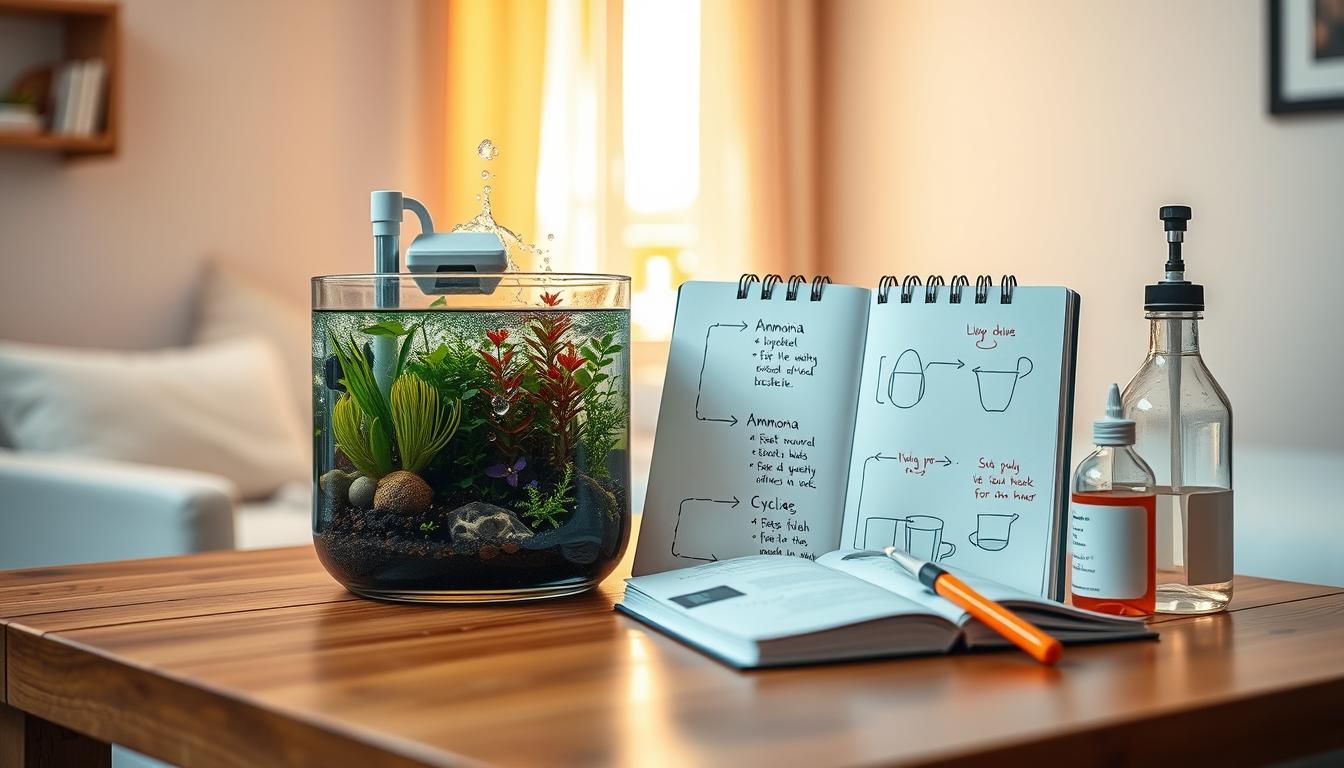
This guide, “How to Cycle Your Nano Tank Without Fish: A Safe Step-by-Step,” helps you prepare a healthy nano aquarium. It does so without risking your fish. You’ll follow a clear fishless cycling guide, perfect for small setups.
Fishless cycling is the safest way to cycle a fish tank. It protects future fish from harmful ammonia and nitrite spikes. With the right products, you can cycle your tank in 8–12 days. Or, it might take 2–6 weeks with traditional methods.
This introduction sets the stage for what’s to come. You’ll learn about setting up your equipment, choosing an ammonia source, and dosing. You’ll also discover how to test regularly and use products like DrTim’s One & Only, Fluval Cycle, and Seachem Stability. The next sections will explain the nitrogen cycle and provide steps to cycle your tank quickly and confidently.
Along the way, you’ll find tips for both planted and community nano tanks. There are also safety considerations and practical tips for lasting results.
What is Fishless Cycling?
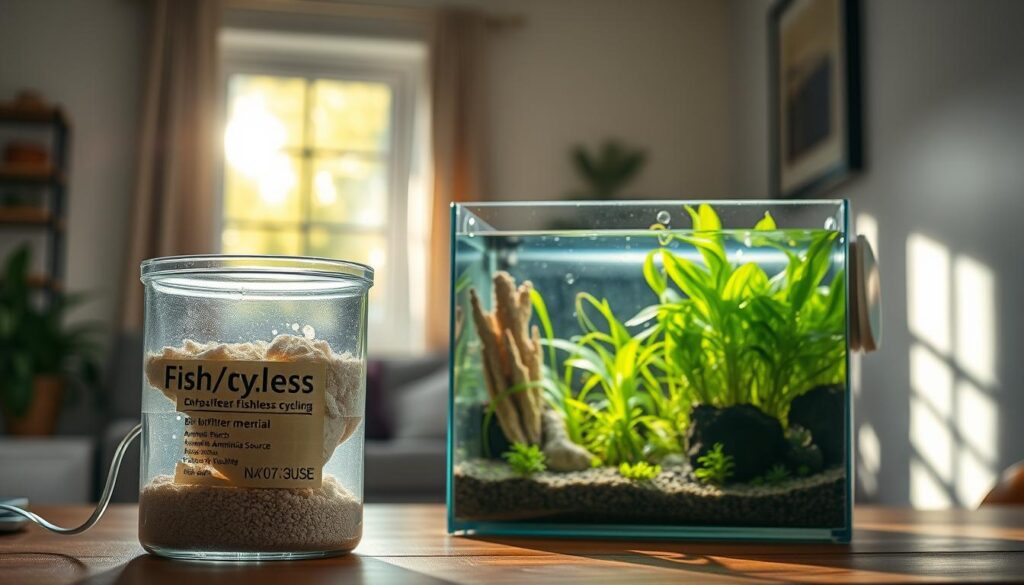
Fishless cycling is a way to start a new aquarium. Instead of fish, you use a controlled ammonia source. This helps grow beneficial bacteria.
These bacteria break down ammonia, nitrite, and nitrate. This makes your tank safe for fish and plants later.
Choosing fishless cycling has big advantages. It avoids the dangers of ammonia and nitrite spikes. This method is faster and safer, perfect for small tanks.
How long it takes depends on the method and tank conditions. Live bacteria products can speed up the process to 8–12 days. Traditional methods might take 2–6 weeks or more.
It’s great for new planted tanks or nano tanks. It’s also good when you can’t get filter media from another tank. Just follow simple steps to keep your tank cycling smoothly.
- Define your ammonia target and add a measured source.
- Test ammonia, nitrite, and nitrate regularly.
- Keep temperature and aeration steady to support bacteria.
- Consider adding seeded media to jump-start cycling a fish tank without fish.
Preparing Your Nano Tank for Cycling
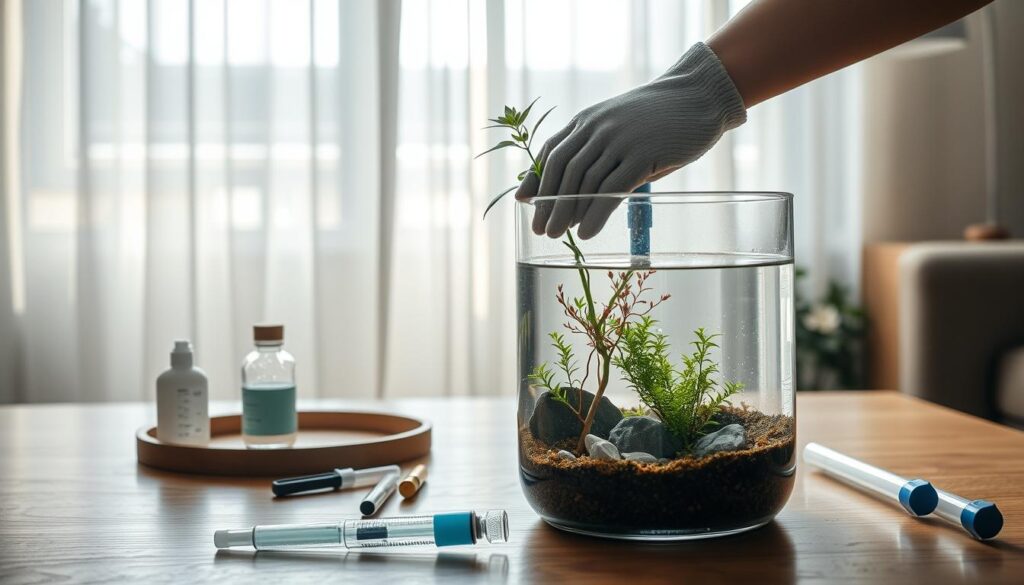
First, set up your tank. Add substrate, a heater if needed, a filter, gentle lights, and decorations. Use dechlorinated water treated with Seachem Prime or Tetra AquaSafe. This prevents chlorine and chloramine from killing the bacteria needed for cycling.
Run all equipment for at least a week before adding ammonia. This lets the filter trap dust and media degas. It also stabilizes temperatures and flows, making cycling steps more predictable.
Keep the tank at 77–86°F (25–30°C) for bacteria growth. This range supports nitrifying bacteria. If you plan to keep cooler-water fish, adjust the temperature to their needs.
Boost oxygen levels for better bacterial growth. Use an air pump or high-flow filters. The Eheim Air Pump 400 or TetraTec APS50 are good choices for aeration. More oxygen helps convert ammonia and nitrite faster.
Adding live plants is a good idea. They absorb harmful substances and provide surfaces for bacteria. A planted tank can cycle faster, like a Walstad-style setup.
Seeding the tank with used filter media or sponge from another aquarium is best. It brings active nitrifying bacteria. Just make sure the source is clean and free of pests or pathogens.
- Complete physical setup and use dechlorinated water.
- Run equipment 24/7 for one week before dosing ammonia.
- Balance temperature for bacteria and future fish.
- Increase oxygen with pumps or stronger flow.
- Use live plants and seeded media to speed cycling.
The Nitrogen Cycle Explained
Learning about the nitrogen cycle helps keep your fish safe and your tank stable. It has three main stages. Each stage involves different bacteria and chemical changes you can check with test kits.
Stage 1 starts with waste, uneaten food, and decaying matter releasing ammonia (NH3/NH4+). Ammonia is very harmful and can quickly increase in a new tank. It’s safer to cycle your tank without fish first.
Stage 2 happens when Nitrosomonas bacteria grow in the filter and substrate. They turn ammonia into nitrite (NO2-). Nitrite is also harmful to fish, so you must watch its levels closely.
Stage 3 comes when Nitrobacter and other bacteria start to work. They change nitrite into nitrate (NO3-). Nitrate is less harmful but you should keep it in check through water changes, plants, or denitrification.
- Goal during fishless cycling: keep ammonia around 2–3 mg/L while dosing actively. Do not exceed about 5 mg/L.
- Cycle complete when a full ammonia dose converts to nitrate and both ammonia and nitrite test near 0 mg/L within about 24 hours.
- Alternate marker: consistent drop in nitrite with a steady rise in nitrate over several tests.
New tank syndrome is when ammonia and nitrite levels get too high, harming fish. Avoiding this by cycling your tank before adding fish is key. Regular testing helps prevent surprises and saves lives.
Temperature and oxygen are important for bacterial growth. Warmer water, within safe ranges for your fish, helps bacteria grow faster. Good aeration is also vital because bacteria need oxygen to work efficiently.
Check readings every day during active cycling. Use this data to adjust your dosing, temperature, and aeration. This hands-on approach helps you control and feel confident as your tank becomes stable and healthy.
Choosing Your Ammonia Source
Starting a fishless cycling guide means picking a good ammonia source first. You need something that gives steady ammonia without extra stuff. Reagent-grade ammonium chloride solutions are best because they let you dose exactly and get the same results every time.
Household cleaners can harm the good bacteria you need. If you’re looking for ammonia for your aquarium, go for products made for aquariums. Brands like DrTim’s offer these, with clear instructions on how much to use.
Using fish food or decaying shrimp can also make ammonia. But these methods are slower and harder to control. They can also bring in unwanted stuff, so be careful.
To make things faster, add bacterial starters to your ammonia. Products like DrTim’s One & Only Live Nitrifying Bacteria can help. They work with your ammonia to speed up the process and make it easier.
- Target about 2–3 mg/L ammonia during fishless cycling.
- Keep peaks below roughly 5 mg/L to avoid inhibiting bacterial growth.
- Use a reliable ammonia test kit to dose accurately and adjust as needed.
When looking for ammonia, choose products from trusted brands. Always read the instructions and follow the dosing charts. This way, your fishless cycling guide will go smoothly and effectively.
Adding Ammonia to Your Tank
Begin after a week of system operation. Use aquarium-grade ammonia to achieve 2 mg/L (2–3 ppm). Use a reliable test kit for this. For DrTim’s, follow the label instructions based on your tank size.
Follow the fishless cycling steps carefully. This method helps build bacteria without harming fish. Start by dosing to 2–3 mg/L and test every 2–3 days. Re-dose when ammonia levels drop. You might need less ammonia as the cycle progresses.
The One & Only rapid method combines ammonia with live bacteria on Day 1. Test daily and add ammonia when levels fall below 1 ppm. Many find it completes in 5–7 days with stable conditions.
Keep a close eye on nitrite levels. If nitrite spikes, reduce ammonia and test often. Never exceed the recommended ammonia levels. High ammonia can slow down bacterial growth.
Ensure steady temperature and good oxygen levels. These conditions help bacteria grow faster. They also improve the conversion of ammonia to nitrite and nitrate.
- Initial dose: reach ~2 mg/L after one week of running.
- Testing cadence: every 2–3 days for traditional method; daily for rapid methods.
- Adjust dose: reduce to half or quarter as the cycle progresses.
Do a final test by adding a full ammonia dose (2–3 mg/L). If ammonia and nitrite are 0 mg/L and nitrate is present within 24 hours, your tank is ready for fish.
Testing Your Water Parameters Regularly
Testing ammonia, nitrite, and nitrate is key for a successful fishless cycle. Use quality kits like JBL Test Combi Set plus NH4 or NT Labs individual tests for accurate readings.
During active cycling, check levels every 24–72 hours. If using One & Only or a fast method, test daily. For standard fishless cycling, test every two to three days. Keep a simple log of date, time, and numbers to track trends.
Watch for an ammonia spike in your tank. Any ammonia above 0 ppm means the source is present or bacteria are not established yet. A rising nitrite confirms Nitrosomonas activity.
- Ammonia >0: source present or insufficient bacteria.
- Nitrite >0: nitrosomonas established; expect a peak before decline.
- Nitrate rising: conversion occurring; this is your final sign of progress.
For accurate ammonia, nitrite, and nitrate testing, choose liquid test kits over cheap strips. Record each reading to know when nitrite drops and nitrate climbs. High nitrate above 20–40 ppm means it’s time for a water change before adding fish.
When doing water changes, use dechlorinated water only. Chlorine or chloramine can harm the beneficial bacteria you need for success.
Have your tools ready: test kit, notebook, and pen. If you see an unexpected ammonia spike, pause additions and repeat tests to confirm. This practice protects your future fish and keeps the cycle on track.
Waiting for the Cycle to Complete
When starting the cycle, patience is key. Test for ammonia, nitrite, and nitrate every day. Look for ammonia and nitrite to drop to 0 mg/L, while nitrate increases after adding ammonia. Stable readings for a few days mean you’re making progress.
The time it takes to cycle a tank varies. Using a live bacterial product can finish in 5–12 days under perfect conditions. Traditional methods take 2–6+ weeks. Heavy planting can also affect the timeline, needing strong light and nutrients.
Consider real-world factors when figuring out the cycle time. Warmer water speeds up bacterial growth, while cooler water slows it down. Good aeration and filter flow help nitrifiers. Adding established filter media or products like Seachem Stability can help if the cycle stalls.
If the cycle is slow, check the temperature and oxygen levels first. A slight temperature increase and better aeration can help. Also, add seeded media if you have it. Avoid using antibiotics or chemicals that harm beneficial bacteria. A full ammonia dose of 2–3 mg/L can confirm the cycle is complete, as ammonia and nitrite should convert to nitrate overnight.
- Signs the cycle is complete: ammonia = 0 mg/L, nitrite = 0 mg/L, nitrate present and stable.
- When to act: persistent nitrite or ammonia, no nitrate rise, or inconsistent test results.
- Quick fixes: add a trusted bacterial starter, seed with media from an established tank, or improve oxygen and temperature control.
After stable readings, do a water change to lower nitrate levels. You might need to make small adjustments for future cycles or new setups. Regular monitoring makes the waiting period safe and controlled for a healthy aquarium.
Adding Beneficial Bacteria
When you add beneficial bacteria, you aim to quickly colonize your tank. This helps nitrosomonas and nitrobacter/Nitrospira grow on surfaces. Using a good bacterial additive can make the cycle shorter and safer for your fish. Always follow the product’s instructions and keep testing ammonia levels.
DrTim’s One & Only, Fluval Cycle, and Seachem Stability are top picks. DrTim’s One & Only can speed up fishless cycling, finishing in under a week with proper ammonia management. Fluval Cycle and Seachem Stability are great for starting new setups with nitrogen-processing bacteria.
Here’s how to cycle a tank with beneficial bacteria:
- Read and follow the manufacturer dosing instructions for any bacterial additives aquarium product.
- Add One & Only on Day 1 with your first ammonia dose if you choose that product; it is formulated to be safe without risk of overdose.
- Keep dosing ammonia to provide a food source so bacteria can establish and multiply.
Natural seeding is another way to start your tank. Move used filter media, ceramic rings, or bio-balls from a healthy tank to seed yours. But only take media from trusted sources to avoid pests or pathogens.
Remember, bacterial additives are just a help, not a replacement for proper cycling. Keep testing until ammonia and nitrite levels drop to zero and nitrate rises. This shows your tank is fully cycled. Stick to a routine and closely monitor your tank’s parameters while cycling.
Safety Considerations During Fishless Cycling
When cycling a fish tank without fish, chemical safety is key. Use aquarium-specific ammonia like DrTim’s Ammonium Chloride. Household cleaning ammonia can harm bacteria and mess up results.
Keep ammonia levels steady and safe. Aim for 2–3 mg/L and don’t go over 5 mg/L. Too much ammonia can harm bacteria and slow the cycle.
Protect your beneficial bacteria during water changes. Treat tap water with a conditioner like Seachem Prime or Tetra AquaSafe. This neutralizes chlorine and chloramine, which can kill bacteria.
Follow electrical and equipment safety rules. Run heaters, filters, and air pumps all the time. Check the manufacturer’s guidelines for safe use from brands like Eheim and TetraTec. Keep cords secure and power strips away from water.
If you seed with media from another tank, be careful. Use healthy tank material to avoid pests and algae. This helps prevent new tank syndrome when you add fish.
- Don’t use antibacterial medications or hydrogen peroxide during cycling. They kill good bacteria and mess up the process.
- Keep records of ammonia, nitrite, and nitrate levels. Track doses and dates to spot trends and avoid ammonia spikes.
Be patient and don’t rush to add fish. Wait for stable readings to confirm the cycle is complete. If you must add fish early, choose hardy species and monitor closely.
Transitioning to Fish-Ready Conditions
Before adding fish, make sure your tank is ready. Add 2–3 mg/L ammonia and watch it drop to 0 mg/L in 24 hours. This shows your biofilter is working well.
Then, lower nitrate levels to safe amounts. Keep it under 20–40 ppm for most fish. If your fish are very sensitive, aim for under 20 ppm. You might need a big water change to get there.
Check the water temperature and pH too. Make sure they match what your fish need. This is true whether you cycled your tank without fish or used products like DrTim’s or Seachem Stability.
Start with a few hardy fish like danios or guppies. Wait a few days to a week before adding more. Test the water every day after adding fish. Keep the water clean by changing it regularly and avoid overfeeding.
Adding live plants can help control ammonia and nitrate. Keep track of your water test results. By following these steps, your nano tank will thrive.
Leave a Reply